Claims regarding the issuance of a UAE Pledge Certificate and a subsequent reward of between AED 2,000 and AED 5,000 can be found on numerous social media platforms, including TikTok, WhatsApp, Facebook, and YouTube.
Participants are reportedly required to complete an online pledge, download the certificate, and then wait for the payment to be processed. While some online posts indicate that the payment will be a bonus, others suggest it will be a payment of financial support, loyalty, or an appreciation reward from the government.
Due to the connection of the certificate to a genuine initiative of the UAE, many assume the reward will also be real.
This is a misconception.
While it is true that the UAE Pledge Certificate will be linked to some legitimate initiative of the UAE on a national and community level, this will not guarantee the authenticity of any claims of financial rewards linked to it.
After analyzing the nature of such pledge initiatives and the kinds of information typically included in viral posts, we can say:
Currently, there is no definitive evidence that acquiring a UAE Pledge Certificate necessitates a payment between AED 2,000 and AED 5,000.
What we do know is the pledge certificate likely serves as a token of appreciation and engagement. It is not a cash voucher, a financial grant, or a benefit approval.
What is the UAE Pledge Certificate?
A pledge certificate is usually awarded following a person’s engagement in an awareness, community responsibility, or public commitment campaign.
Such initiatives may encourage the public to show support for the following values:
- National unity
- Tolerance and peaceful coexistence
- Community responsibility
- Adherence to and respect for UAE laws and institutions
- Protection of the environment
- Safety in the digital space
- Public health awareness
- Loyalty and appreciation to the nation
Participants who complete the pledge may then download a digital certificate bearing their name.
Usually, the certificate can be saved or shared via social media. It is meant to recognize one’s participation and to propagate the campaign message.
It must be known that a digital Certificate of Appreciation is not a financial document and does not entail automatic eligibility for a government payment.
What is the Claim Going Viral?
The claim that is going viral appears in several iterations.
Some entries say things like:
- “Complete the UAE Pledge and receive AED 2,000.”
- “Download your certificate and claim AED 5,000.”
- “UAE residents can get a cash reward after signing the pledge.”
- “The government is giving financial support to certificate holders.”
- “Register now before the application closes.”
There is a tendency to use specific language to generate an element of urgency. For example, posters sometimes write that offers are valid for a limited time or will only be provided to the first so many applicants.
Usually, posters do not include any announcements by the government, detailed requirements for eligibility or a reliable description of how the payments will be processed.
This alone should be a big red flag.
Valid government initiated financial assistance programs should provide the following:
- Eligibility criteria
- Amount of assistance
- Sponsoring agency
- Evaluation criteria
- Required documentation
- Disbursement schedule
- Program sunset
- Reference to official terms and conditions
Any social media or WhatsApp message that describes a “free money” program should be considered an announcement.
Are there official AED 2,000–5,000 rewards?
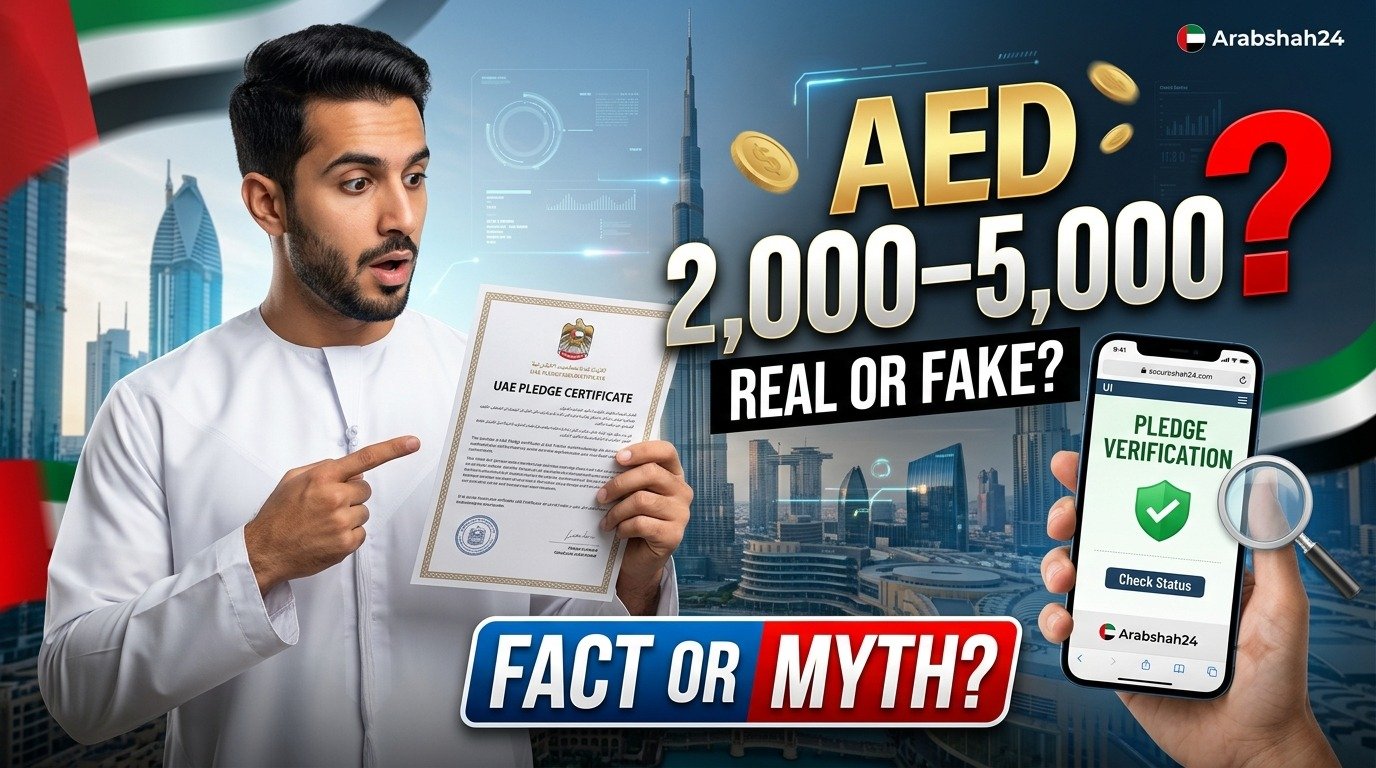
Currently, there is no reliable information to support that a cash reward of AED 2,000, AED 5,000 or any amount will be paid to every pledge signatory or certificate downloader.
The usual participation pledge process is collection of relevant information needed to generate a certificate. This is not an application for a loan, salary advance, social security, grant, or investment return.
A participation pledge certificate process would not typically involve:
- A debit or credit card number
- Card PIN
- CVV code
- Banking password
- One-time password (OTP)
- Prepayment
- Reward collection fee
- Tax clearance fee
- Certificate activation fee
Any website offering to give a reward of AED 2,000 – 5,000 and asking for the above information should raise a red flag.
It is safest to assume that any such certificate is most likely authentic, but it cannot be trusted that the cash payment will be made. This should only be considered to be true if it has been officially confirmed by a government entity in the UAE.
Why Do People Fall for It?
The main reason for people believing in this scheme is that the fraudulent poster combines a certificate with a promise of easy money.
The reality is that many people simply do not have the time to fact-check all of the information that circulates on the internet. Scammers, knowing that people do not have time to investigate, use things like UAE national flags, logos, and pictures of national leaders in their posts so people assume that they are legitimate.
Many times, posts will cite real government initiatives, and claim a cash payment, prize, or guaranteed benefit.
This method works because users can search for initiative names. Users might find that initiatives are real. Users might think that rewards can be claimed too, because they have found initiative information.
This is incorrect, because initiatives being real does not mean rewards being real.
Users will have to check each claiming part separately.
Fake Reward Scheme Example
Fake Reward Scheme campaigns have a method they generally follow.
Step 1: An Attractive Message
A campaign’s first step is the victim getting a message about potentially getting thousands of dirhams if they are a certificate holder, or a resident in the UAE.
The message might use wording such as:
- “Congratulations”
- “You have been selected”
- “Claim Your Payment Now”
- “Limited applications available”
- “Registration closes today”
This is to promote urgency and excitement, which will lead to the user not thinking carefully about the message.
Step 2: A Suspicious Link
Messages will have links that direct to suspiciously official looking websites.
These websites may display the UAE flag, and use UAE government colors in conjunction with ministry logos and/or building images, however, the URL will be a slightly different version of an official government URL.
Step 3: Personal Information is Collected
You may need to provide the following:
- Name
- Phone number
- Emirates ID
- Passport
- Residence
- Work
- Bank details
Some of these requests may seem benign, but they can still be employed to steal identities, perpetrate focused phishing attacks, or gain unauthorized access to accounts.
Step 4: A Fee is Charged
Websites that employ this tactic assert that users must pay a fee to either activate the certificate or collect the reward.
These fees can be as little as AED 10, AED 20, or AED 50.
Many users become victims of this scheme as they are incentivized by the possibility of obtaining a reward of greater value, even if only in the short term. Long-term consequences of entering payment information can be loss of more money due to the additional financial attacks.
Step 5: An OTP is Required
One Time Passwords are the most dangerous piece of information to provide.
OTPs can be the final authorization for a payment or transaction. A legitimate reward program does not require the OTP that has been sent.
When you are asked for bank OTPs, do not provide them.
Common Warning Signs
There are several warning signs that should lead internet users to be skeptical of reward offers associated with the UAE.
No Official Release
A legitimate government payment program would be communicated through a recognized media outlet, or announced on an official website or verified account.
A forwarded WhatsApp message is not an official release.
Too Good To Be True (TGTBT) Offers
It sounds like a scam. You cannot possibly receive thousands of dirhams just for entering your name and downloading a certificate, can you?
Offers that sound TGTBT usually are.
Unprofessional Pages
Spelling and grammatical errors, odd or poorly done translations, and inconsistent formatting are all signs of unprofessional page design.
As such, just because a page appears professionally designed, it does not mean it is legitimate.
Too Much Urgency
Offers that are time sensitive or have a limited time only quantity are especially designed to create a sense of urgency to act, thereby preventing you from taking the time to verify an offer’s legitimacy.
Unreasonable Requests
Pledges that are digital and require a form of payment or personal banking information are clear signs of a scam.
Red Flags
Asking you to pay a fee to process or activate a gift you are promised is one of the clearest signs of a scam.
Name Game
Fake websites, also called phishing websites, often have names that are a slight variation of legitimate websites.
You should pay careful attention to the web address and site name, especially if they request you to enter sensitive information.
Refer a Friend
Many scams operate under the guise of a reward system. These systems require the initial participant to refer a set number of additional participants to the system (often via a message or email) before they can claim their reward.
This is primarily a marketing tactic to further distribute the scam.
Mandatory Checks Before Applying to Financial Offers from UAE Government
Users should perform some preliminary checks before applying for financial services from the government.
Official Channels
Do not open links sent via social media. Rather, check if there are formal announcements regarding a financial program on UAE Government official websites.
Official platforms usually clearly state the purpose and eligibility criteria, and describe the application process.
Look for the Responsible Authority
A legitimate program should name the ministry, department, or government agency that is implementing it.
If no authority is mentioned, the program should be considered unreliable.
Analyze the Eligibility Criteria
Government funding usually has particular criteria. It is rare that there are no criteria and that funding is available to all.
Check for criteria related to age, residency status, employment status, income, etc.
Reach Out to the Authority
If you have any questions or concerns, feel free to reach out to the authority whose contact information is on their official website.
Don’t use the contact information that is included in a suspicious message.
Search for Information in Trusted Media
A big nationwide government program would be covered by the news.
If you can only find the information on social media and it is not cited by an official source, be careful.
Is the Certificate Worth Anything?
Yes, as long as you understand its purpose.
A pledge certificate can represent support for the ideals of the nation, support for unity, tolerance, and community involvement.
Participants can keep the certificate as a digital record or can share it online to motivate others to participate in this campaign.
Just because the program does not give cash rewards, does not mean the program is fake or of no value.
Things get out of hand when people attach unsubstantiated financial commitments to the certificate.
The following should not be accepted as a participation certificate:
- Evidence of financial eligibility
- Payment of a government grant
- Payment of a support salary
- Social support
- Guarantee of a visa
- Job offer
- Certificate of investment
- Evidence of payment
Participation is encouraged because users believe in the message of the initiative. Not because of a stranger’s promise for free money.
What to do if you have given your details
It is important to take action if you have provided personal details to any of the online reward systems.
Contact your bank
You should call the bank directly using the number advertised.
Explain the details you provided and what action the bank can take to protect your account.
Check your account for
- a) Test transactions
- b) Payments to unknown recipients
- c) Transactions of a value significantly lower than what is normal.
Report any of the above.
Change your passwords
Change the passwords for your email account, banking applications and any other sensitive account.
Use of Account Control Apps
Enhance the control and protection of your accounts by using account control apps, where available.
Reject all UAE PASS Requests
Fraudsters often ignore standard operating procedures and will send requests for UAE PASS approvals.
Never approve a request unless you initiated the process and understand the request.
Collect and protect all unsolicited evidence
Fraud systems request payments and often include messages, unsolicited phone calls, and websites. Collect and protect all evidence.
Report the fraud
Cybercrime can be reported through the appropriate UAE police or official digital-security portals.
Victims of crimes have a duty to report early so that authorities can intercept predators before they have a chance to target additional victims.
Important Advice on Safety for UAE Residents
Scams have reached a new level of sophistication. With the ability to create fake websites that can be nearly identical to real websites, visual confirmation can no longer be sufficient to determine legitimacy.
Residents are advised to adhere to the following general rules:
- An OTP should never be shared with anyone.
- Bank PINs and passwords should never be shared.
- Do not approve any requests for your digital identity that you did not initiate.
- Do not click on links that have been shortened or links that you do not recognize.
- Do not pay to claim a prize or reward that has been advertised as free.
- If you are unsure of a government offer, confirm its validity with official sources.
- Do not accept payment proof that is only a screenshot.
- Use caution with messages that have been forwarded.
- Just because a message was not sent by a stranger, does not mean it should not be verified.
Common Questions
Is the UAE Pledge Certificate legit?
While pledge certificates may be real, national or community initiatives, they should only be accessed by their appropriate official channels.
Is it true all Pledge Certificate holders receive AED 2,000?
There is no proof that all Pledge Certificate holders receive AED 2,000.
Is it true AED 5,000 will be given to some as a result of the pledge?
There is no proof that completion of the pledge will result payment of AED 5,000 to participants.
Is there a registration fee?
An ordinary digital pledge and certificate of participation should not encounter a reward release or activation fee.
Should I enter my bank details?
Bank or card details should not be entered on a page that offers a reward in the form of a certificate, among other things.
Can I share my certificate on social media?
Participants can share their personal certificates; however, some personal information should be concealed prior to a public post.
What if a social media influencer says the payment is real?
Popularity is not proof. Always ask for the official communication and validate it on your own.
What if I already paid a processing fee?
Immediately contact your financial institution, assess your account and report the site or message to cybercrime via their official reporting tool.
Arabshah24 Fact-Check Verdict
Arabshah24 does not find any credible evidence to support the claim that holders of the UAE Pledge Certificate are promised AED 2,000 – 5,000.
Here is the most informed position:
- The pledge initiative or certificate may be authentic.
- The certificate may simply represent participation.
- No official sources confirm a payment in the range of AED 2,000 – 5,000 is guaranteed.
- Requests for card details, OTPs or processing payments are to be considered suspicious.
Final Verdict: False or Misleading
The promise of payment is totally unsupported. The claim combines a certificate that appears to be real with a promise of payment.
Final Words
The UAE routinely launches new and valuable social, cultural and community initiatives. The popularity of these initiatives inevitably attracts scammers and misleading social media pages.
The UAE Pledge Certificate signifies participation and appreciation and should not be assumed to mean that the holder will gain a monetary reward of several thousand dirhams.
Reward offers on the internet should not be blindly trusted and should always be verified before being acted upon. Passwords, PINs, CVVs, and OTPs should never be given to strangers and payments should never be made to strangers in the belief that a government payment will be released.
The conclusion of Arabshah24 is clear:
The certificate is likely genuine, but there is no official information to support the claim that it guarantees a payment of AED 2,000–5,000.
Verify offers that claim to provide rewards with due diligence. Offers that are not confirmed by the government, have no eligibility criteria and provide rewards that claim to be easy to obtain should be assumed to be scams.