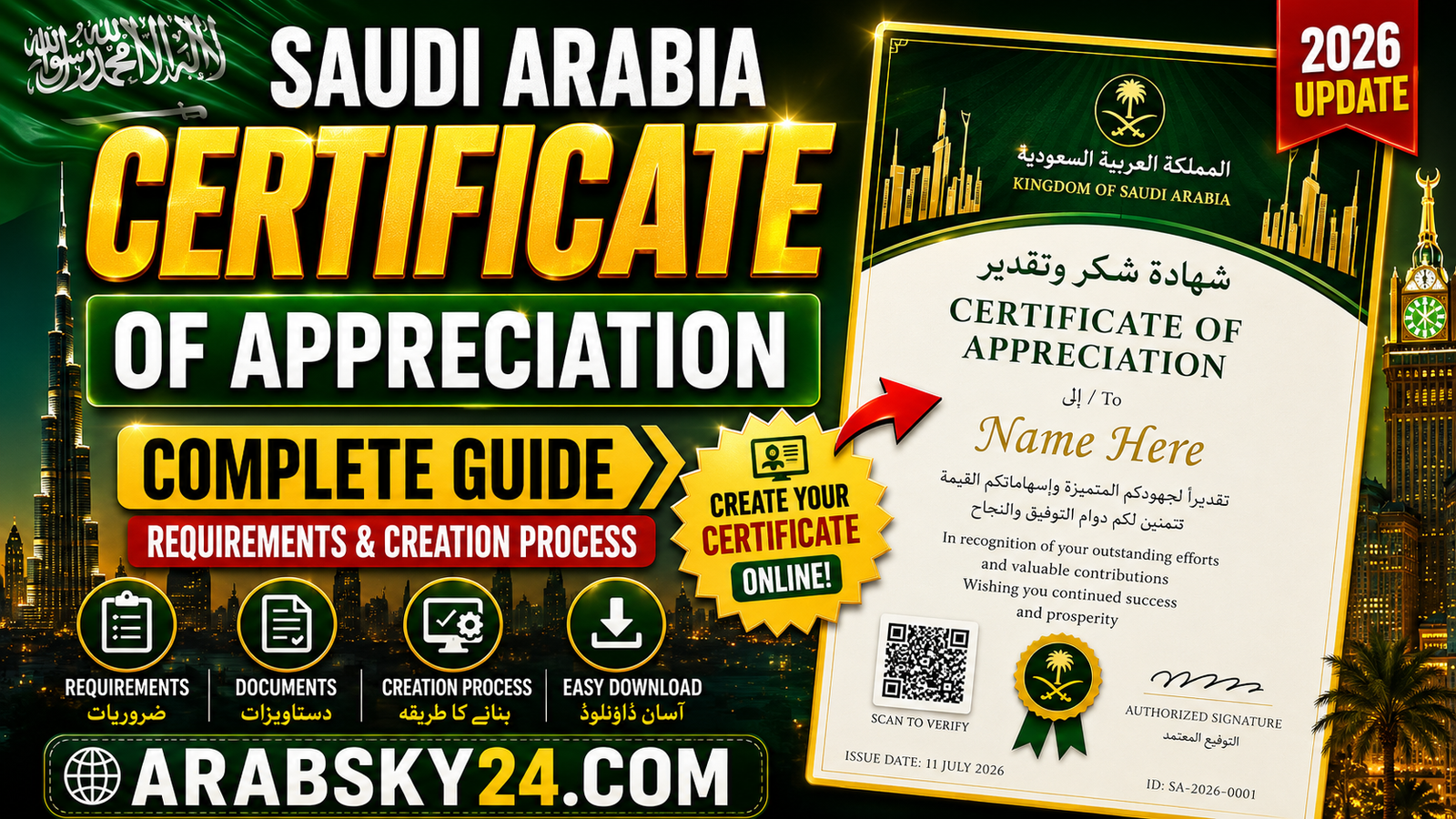
A Certificate of Appreciation is an easy way to acknowledge someone’s effort, dedication, service, achievement, or participation. In Saudi Arabia, certificates of appreciation are issued by organizations such as companies, schools, training institutions, charitable organizations, event organizers, community groups, and professional associations. Even though these entities are issuing certificates in an organized manner, certificates of appreciation are primarily personal and are intended to tell the recipient that their effort was recognized and appreciated.
Certificates of appreciation that are well designed can boost staff morale, help strengthen the bond with volunteers and business associates, and/or provide students and participants with a lifelong record of recognition. On the contrary, poorly designed certificates can appear to be informal, represent incomplete or incorrect information, and can result in ambiguity as to what the certificate represents.
Through this Arabsky24 guide, you will learn everything important to know about the Saudi Arabia Certificate of Appreciation, the information a Certificate of Appreciation should comprise, if there is a need for government approval or attestation, and how to design a professional certificate of appreciation.
What is Certificate of Appreciation?
A Certificate of Appreciation is a document that is used to recognize an individual or a group of people for an effort, service, achievement, or positive contribution in a particular context, and is typically issued by an entity. It is not an academic certificate, a professional license, a certificate for training, an employment certificate, or a government issued permit.
For instance, a company may issue a Certificate of Appreciation to an employee for their commendable effort in achievement or service to the company. A school may also issue a Certificate of Appreciation to a teacher, student, or guest, in addition to a winner of a school competition. A charity may also issue a Certificate of Appreciation to a volunteer or donor, and an event organizer may issue a Certificate of Appreciation to a sponsor, a speaker, a judge, or a participant.
Certificates may be printed, delivered as PDF files, or issued via a digital certificate verification system. Their primary value stems from the issuer’s reputation, information integrity, and the certificate’s verification seal.
General Applications in Saudi Arabia
Certificates are presented to employees, students, volunteers, teachers, speakers, sponsors, judges, donors, project teams, community partners, and participants. They are also awarded for activities related to workshops, exhibitions, schools, charity, sports, the Saudi National Day, retirements, and corporate functions.
Be specific when stating the reason the certificate is being awarded. Otherwise, use a generic statement such as “for excellence,” which holds little meaning.
The following example provides the reason in a meaningful way:
“In appreciation of your valuable contribution to the Annual Customer Service Conference.”
The wording essentially explains to the recipient the contribution being awarded.
Is There a Need for Government Approval?
For a standard in-house appreciation certificate presented by a private company, school, association, or event organizer, there generally is no Saudi government standard or unified procedure. The certificate, as a rule, is printed and signed by the presenting organization.
Nonetheless, a standard appreciation certificate should not be misrepresented as something it is not. For example, it should not state it is a certificate for an academic degree, a credential for an accredited training, a professional license, or an award from a governmental entity.
Include the organization’s official name and logo. Identify the reason for recognition. Include the name and title of the authorized signatory. Avoid using governmental emblems or branding, or logos of ministries or other companies without permission.
Business identity registration and trading name regulations in Saudi Arabia require that the issuer use their actual name and prohibits the issuer from using an invented, unofficial, or misleading business name.
Do Certificates of Appreciation Need Attestation?
Certificates of Appreciation are typically awarded in-house, and given their ceremonial nature, are generally not attested. Where attestation is applicable, a receiving authority will inform that attestation is necessary for a formal legal, business, employment, immigration, or international purpose.
The ratification services of the Ministry of Foreign Affairs of the Kingdom of Saudi Arabia are applicable to documents of trade, education, letters, powers of attorney, marriage contracts, and personal status documents. The purpose of the services is to provide these documents the legal standing to be recognized in other jurisdictions.
Certificates of Appreciation should not be assumed to be eligible for attestation. It is prudent to directly contact the relevant receiving entity to determine what they will accept and what, if any, verification is required. Certificates of Appreciation will not fulfill the following:
- Employment Experience Letter
- Salary Certificate
- Academic Transcript
- Professional Membership Certificate
- Accredited Training Certificate
- Course Completion Certificate
- Qualification Certificates
Each document has a distinct purpose and may be subject to its own verification requirements.
Important Certificate Standards
Though there is no one-size-fits-all design, a professional Saudi Arabia Certificate of Appreciation will usually have the following features.
1. Issuing Organization
Show the complete, official title of the organization and include the logo if the organization owns the logo or has permission to include the logo.
If the certificate is issued by two organizations, both organizations will have their complete, official title along with their logo. The design will not imply that one organization is the only issuer of the certificate unless that is the case.
2. Title of Certificate
A simple and clear title such as one of the following will work:
- Certificate of Appreciation
- Certificate of Recognition
- Award of Appreciation
- شهادة شكر وتقدير
- شهادة تقدير
The title of the certificate will be easy to identify and will be located at the top of the certificate in a larger font than the text on the certificate.
3. Recipient’s Complete Name
The name will be in the form that is most official. In the case of formal corporate activities, the name should be confirmed via an employee record or an identification document.
There should be no inclusion of an iqama number, national ID, passport number, or employee number unless absolutely necessary and the case warrants it.
Saudi Arabia’s Personal Data Protection Law refers to names, identification numbers, addresses, and contact details including personal records.
Organizations should gather only the information necessary for certificate issuance. Organizations should also keep recipient lists confidential and should not publish certificates on the internet without the appropriate cause and the recipient’s consent.
4. Appreciation Statement
State the reason for recognition. The statement should be honest, detailed, and clear.
For example:
“This certificate is proudly presented to Sarah Ahmed in recognition of her dedicated service and important contribution to the Customer Experience Improvement Project.”
Avoid excessively large sections. The goal of the certificate should be clear in seconds.
5. Event, Project, or Achievement
State the name of the relevant program, campaign, department, conference, project, school year, competition, or activity.
This information creates proper context for the recognition and aids the certificate in serving a personal or professional purpose.
6. Date and Place of Issue
State the date that the certificate is awarded or officially sanctioned.
The certificate may use:
- The Gregorian date
- The Hijri date
- Both the Gregorian and Hijri dates
Using both dates is helpful for formal or Saudi-related occasions.
You may also add city or local context when appropriate such as Riyadh, Jeddah, Dammam, Makkah, Madinah, Al Khobar, Abha, Tabuk, and other locations.
7. Authorized Signature
This should include the name and title of the person who grants the certificate along with their signature.
This could be one of the following titles depending on the organization:
- Chief Executive Officer
- General Manager
- Head of Department
- Human Resources Manager
- Principal
- Programme Director
- Chair of the Event
- Training Manager
- Project Manager
The signatory must have the authority to approve recognition on behalf of the issuing organization.
8. Stamp, Serial Number, and Verification
The use of a company stamp is not mandatory, but may lend added value to the certificate as per the organization’s internal policy.
When many certificates are issued, a unique certificate number is important. It aids in issuing the certificate, as well as facilitates requests to amend records and to verify the certificate.
An example of a unique certificate reference is:
APP-2026-0047
This reference may indicate the certificate category, year, department, program code, and serial number.
For large scale programs, the organization may include a QR code or a secure verification link to indicate:
- Name of the recipient
- Certificate number
- Title of recognition
- Date of issuance
- Name of the issuing organization
- Status of verification
No private information of employees or students should be disclosed on a public verification page.
Arabic, English or Bilingual Certificate?
Saudi organizations may issue Certificates of Appreciation in Arabic, English, or both.
Arabic is appropriate for local schools, community programs, activities related to and organized by government and charitable organizations, and organizations that work in Arabic.
English is prevalent in multinational companies, universities, international workshops and member countries activities, and workplaces with employees of different nationalities.
Certificates with both Arabic and English are the most appropriate.
When reviewing bilingual certificates, ensure the reviewer checks names, titles, grammar, honorifics, punctuation, dates, etc. Make sure both languages are aligned, with optimal balance and spacing, and check names that are lengthy and right-to-left (R/L) before printing.
You should not rely solely on a translation provided by a machine. Given that the structures of the English and Arabic languages differ, a sentence that works for English may not for Arabic, and vice-versa.
A Comprehensive Guide to Creating a Certificate
Purpose of the Certificate
Explain, in one sentence, the purpose of the award.
When writing, consider the:
- award recipient
- award presenter (if different from the issuer)
- award reason
- award occasion (the event for which the award is given)
- award contributor
Define how formal you would like the certificate (to guide word choice), then consider the design and signatures (to define how the certificate will be presented).
Confirming the Approver and Issuer
Define the department, school, program, etc. that will be the awarding body of the certificate.
Define the person authorized to sign or approve the certificate.
For large corporate programs, ensure the awarding body approves the certificate prior to its production.
Recipient List
A recipient list is a spreadsheet that captures, for the approved recipients, the:
- name (with Arabic and English translations, if available)
- reason for the award
- department or organization
- date award is issued
- award number
- how the certificate will be delivered
- if the certificate is approved
Define the recipient list one time so different members of the team do not capture names in varying formats.
Language and Wording
The certificate can be bilingual, or in Arabic or English alone (your choice).
Final wording for the certificate should be obtained prior to beginning the design of the certificate.
This will avoid issues with alignment, translation, spacing, and formatting.
Step 5: Sizes and Formats
For certificates that require bilingual text, signatures, and other certificate-related information, the A4 size in landscape format is ideal. For a more formal and traditional look, the A4 size in portrait format is recommended. Certificates are usually presented in digital format as high quality PDF files. For printed certificates, a good quality paper would be a card stock of 200-300 gsm, depending on the purpose and what is needed for the presentation.
Step 6: Layout Design
When designing the layout for your certificate, use the brand colors of the sponsoring organization and ensure the text is legible.
The following elements are typically included in a well-organized and balanced layout:
- Decorative border
- Organization logo
- Certificate title
- Recipient name
- Appreciation statement
- Event or project name
- Issue date
- Signature area
- Certificate number
- QR code, where needed
Localized character design, such as the use of Saudi-inspired geometric design, is encouraged. However, the use of excessive decoration, such as clip art, heavy gradients, overcrowding the design or using too many colors should be avoided.
Step 7: Incorporate Verification Features
For small, internal events, a certificate number and signature should be adequate.
For large or high-value recognition programs, you should consider adding:
- QR code
- Digital certificate records
- Controlled verification page
- Watermark
- Embossed seal
- Digital signature
- Unique serial number
Saudi Arabia’s Electronic Transactions Law provides a framework to support electronic transactions and signatures. If stronger digital affirmation is needed, use a digital signature or digital certificate solution, instead of simply affixing a scanned signature to a PDF.
You should check:
- Recipient’s name
- Date
- City
- Title
- Certificate number
- Arabic
- English
- Name of the Organization
- Logo
- Signatory’s title
Before you print the batch, export or print one sample.
A helpful quality control method is to have one person prepare the certificates and have another person compare the certificates to the approved recipient list.
Obtain the approved signature, and/or digital stamp, and/or seal on the certificate.
The certificate can be:
- delivered in person at an event,
- emailed,
- delivered in person as a printed copy,
- uploaded to the employee portal,
- uploaded to the student portal, or
- shared by a secure certificate platform.
You should maintain a register of the certificate’s:
- Certificate number
- Recipient’s name
- Reason for recognition
- Date issued
- Issuing department
- Approving authority
- Delivery status
If a recipient needs a corrected certificate, cancel the original certificate and issue a new corrected certificate instead of editing the original document.
Tips for Designing Professional Certificates
An elegant balance of simplicity and sophistication in your design should make your certificate look and feel important. Prominent placement of the recipient’s name and an appropriately sized ‘Appreciation’ statement with plenty of whitespace around both will help achieve this effect.
One decorative font is sufficient, and spacing signatures and utilizing crisp logos will help elevate your design.
With regards to Arabic name certificates, be sure to test the spacing with longer names. Avoid design flaws that appear as a stretched or unofficial logo, missing an emblem, spelling mistakes, signature forgery and the use of boilerplate text.
Your design should be representative of both the professionalism and the reputation of the company or issuing partner.
Sample Certificate Text
English Version of Certificate
Certificate of Appreciation
This certificate is proudly presented to
[Recipient’s Full Name]
for your full and valuable participation, commitment, and support to
[Project, Event, Department, or Organization].
Your contribution is recognized with deepest appreciation.
Dated and signed in [City] this [Date].
[Authorized Person’s Name]
[Job Title]
Certificate Number: [Number]
Bilingual Certificate Opening
شهادة شكر وتقدير
Certificate of Appreciation
تمنح هذه الشهادة
This certificate is proudly presented to
[اسم المستفيد / Recipient’s Name]
تقديراً لمساهمته القيمة و جهوده المتميزة في
In recognition of outstanding efforts and valuable contribution to
[اسم المبادرة أو الجهة / Programme or Organization]
The final design in Arabic should be reviewed by a professional fluent in Arabic before it is printed, published, or distributed.
Common Mistakes to Avoid
The most frequent error is spelling the name of the recipient incorrectly. Other issues include:
- Missing date of issue.
- Reason for recognition not clear.
- Logos without permission.
- Incorrect alignment for Arabic.
- Signatures are copied or unofficial.
- Same numbers on certificates issued.
- Wrong designation.
- Image printed in poor quality.
- Date format variation.
- Missing details of issuer.
Another frequent mistake is the use of the words “completion” or “certification” to describe simple participation where there was no course or evaluation.
Ensure the words are used properly. Participation in an event is described as “in appreciation of participation.” If an event participant has completed a training session, a separate course completion certificate should be issued, if applicable.
When posting certificates on social media, organizations should be careful to conceal any personal or sensitive details such as employee numbers, IDs or national numbers, contact information, signatures, or QR codes.
Frequently Asked Questions
Is a signature mandatory?
For a simple internal recognition document, a signature may not be necessary, but it adds great value. Formal recognition documents require a signature or a stamp by an authorized person.
Should iqama or national ID numbers be on the certificate?
In most cases, no. An identification number should only be added if it is required for a legitimate purpose of verification. In most cases, a unique number issued for a certificate suffices.
Is a Certificate of Appreciation an experience certificate?
No. A Certificate of Appreciation recognizes an achievement, a service, or a contribution.
An experience certificate is a recognition of a person’s previous employment, designation, duties and responsibilities, and the period of service.
How to Verify a Certificate?
Certificates can be verified by:
- unique serial number
- official organization email
- QR code
- digital signature
- secure online verification
- certificate register of the organization
Can a Certificate of Appreciation be used for a job application?
A Certificate of Appreciation can be used as evidence for recognition or achievement. However, it does not substitute for academic qualifications, employment history, experience letters and professional licenses.
Conclusion
There are simple and valid ways to design a Saudi Arabia Certificate of Appreciation.
There should be a reason for the recognition, the correct name of the recipient, a message, an authorized signature and a record of issuance.
Certificate design and approval is usually an internal function of the issuing organization, for general recognition of employees, students volunteers and participants. However, for legal use, international submission, accreditation or government acceptance, the issuing organization should confirm with the relevant authority the exact requirements for attestation or the presented document as an official certificate.
A well-designed Certificate of Appreciation captures the essence of respect for professionalism and recognition of achievement.